
STINCO provides copper alloy casting and machining services for marine equipment components, including pump castings, pump blades, impellers and other custom parts made according to customer drawings and application requirements.
Our manufacturing capabilities support projects that require material selection, casting process planning, heat treatment, CNC machining and inspection coordination in one integrated production system.
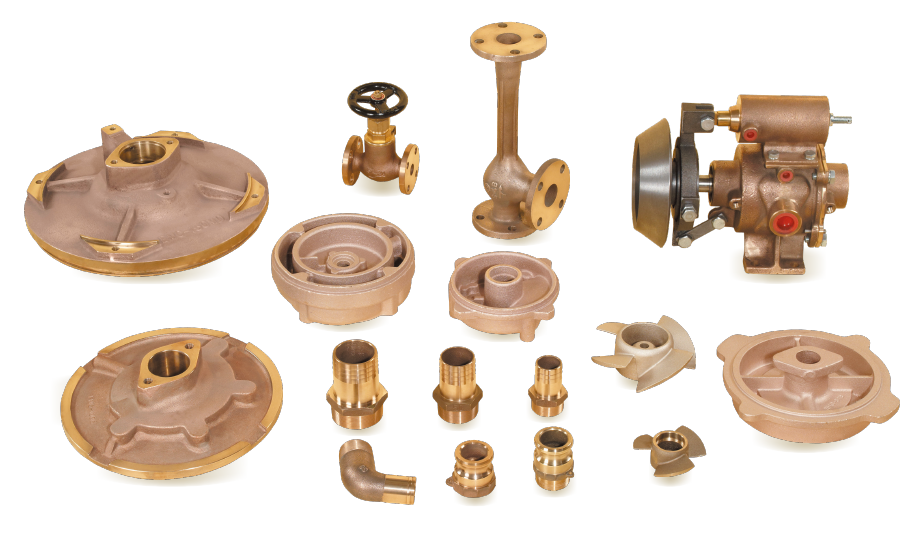
What Are Marine Equipment Castings?
Marine equipment castings are metal components manufactured by pouring molten metal into a mold to create the required shape. This process is suitable for producing complex geometries, large components and parts that require specific mechanical or corrosion-resistant properties.
For ship equipment, cast components may include:
The appropriate material and casting process depend on the component’s function, operating environment, dimensions, production quantity and drawing requirements.
Why Are Copper Alloy Castings Used in Marine Equipment?
Copper alloys are commonly considered for marine components because different copper alloy grades can provide combinations of corrosion resistance, strength, wear resistance and machinability.
For seawater-related applications, the material must be selected according to the actual operating conditions. These may include seawater exposure, flow velocity, pressure, temperature, cavitation risk and contact with other materials.
STINCO can discuss copper alloy selection based on the customer’s drawings and application requirements. Where applicable, materials may include bronze or aluminum bronze grades such as ASTM C95800, subject to customer specifications and engineering review.
What Marine Pump Components Can STINCO Manufacture?
STINCO can support the production of custom pump components based on supplied drawings, specifications or technical discussions.
Potential components include:
Each component requires different attention during mold design, metal filling, solidification, machining and inspection. For example, an impeller may require close control of blade geometry and balance-related dimensions, while a pump casing may require accurate internal passages, flange surfaces and mounting features.
The final scope should be confirmed according to the customer’s drawings and production requirements.
Equipment & Capabilities
Which Casting Process Is Suitable for Ship Equipment Parts?
There is no single casting process suitable for every marine component. The process should be selected according to the part design and production conditions.
| Component condition | Possible casting approach | Main consideration |
|---|---|---|
| Large or heavy components | Furan sand molding or gravity casting | Mold size, filling, solidification and handling |
| Small components with complex geometry | Investment or lost-wax casting | Detail reproduction and dimensional requirements |
| Components requiring specific shapes or quantities | Process selected after drawing review | Cost, tooling, lead time and repeatability |
| Castings requiring finished interfaces | Casting followed by CNC machining | Critical dimensions and assembly fit |
Which Copper Alloys Are Used for Marine Equipment Castings?
There is no single casting process suitable for every marine component. The process should be selected according to the part design and production conditions.
| UNS No. | Common Name | Typical Applications |
|---|---|---|
| C95800 | Nickel Aluminum Bronze | Seawater pump casings, pump bodies, impellers, impeller blades, valves, wear rings and other high-strength marine components |
| C95500 | Nickel Aluminum Bronze | Marine pump components, impellers, pump blades, propeller components, shafts, valves and heavy-duty wear components |
| C95400 | Aluminum Bronze | Pump housings, pump components, impellers, impeller blades, valves, bearings and marine hardware |
| C90700 | Tin Bronze | Pump bodies, valve bodies, pump impellers, pump rotors, pump stators and water-turbine components |
| C83600 | Gunmetal / Red Brass | Pump bodies, pump covers, valve bodies, stern-tube components, deck fittings, gears and bearings |
| C90800 | High-Leaded Tin Bronze | Marine bearings, bushings, couplings, gears and other ship machinery components requiring wear resistance |
| C91700 | Nickel Tin Bronze | Marine bearings, bushings, gears, couplings and other seawater-exposed mechanical components |
| C96200 | Cast Copper-Nickel Alloy | Seawater pump bodies, valve bodies, fittings, flanges and seawater cooling-system components |
Material selection note:
The alloy information above is provided as a general reference for marine equipment castings. The final material grade should be confirmed according to the component drawing, operating medium, pressure, temperature, cavitation risk, corrosion conditions, mechanical requirements and applicable customer standard. Chemical composition and mechanical properties should be verified against the agreed material specification and inspection requirements.